Headless LMS Architecture vs. Monolithic Platforms: The Enterprise Buyer’s Evaluation Framework
4 minutes to read

The Structural Shift in Enterprise Learning Infrastructure
Enterprise learning technology is moving away from rigid, all-in-one architectures toward decoupled, composable ecosystems. Historically, the monolithic Learning Management System (LMS) bundled presentation layers, course delivery, administrative business logic, and learner record databases into a single codebase. While this model met early corporate compliance requirements, it now poses technical challenges for distributed global workforces.Enterprise organizations frequently encounter severe UI constraints, integration friction, and walled-garden data models. Adopting a headless LMS architecture addresses these bottlenecks by decoupling frontend learner experiences from the backend learning engine, enabling technical leaders to deliver contextual training directly into enterprise workflows.
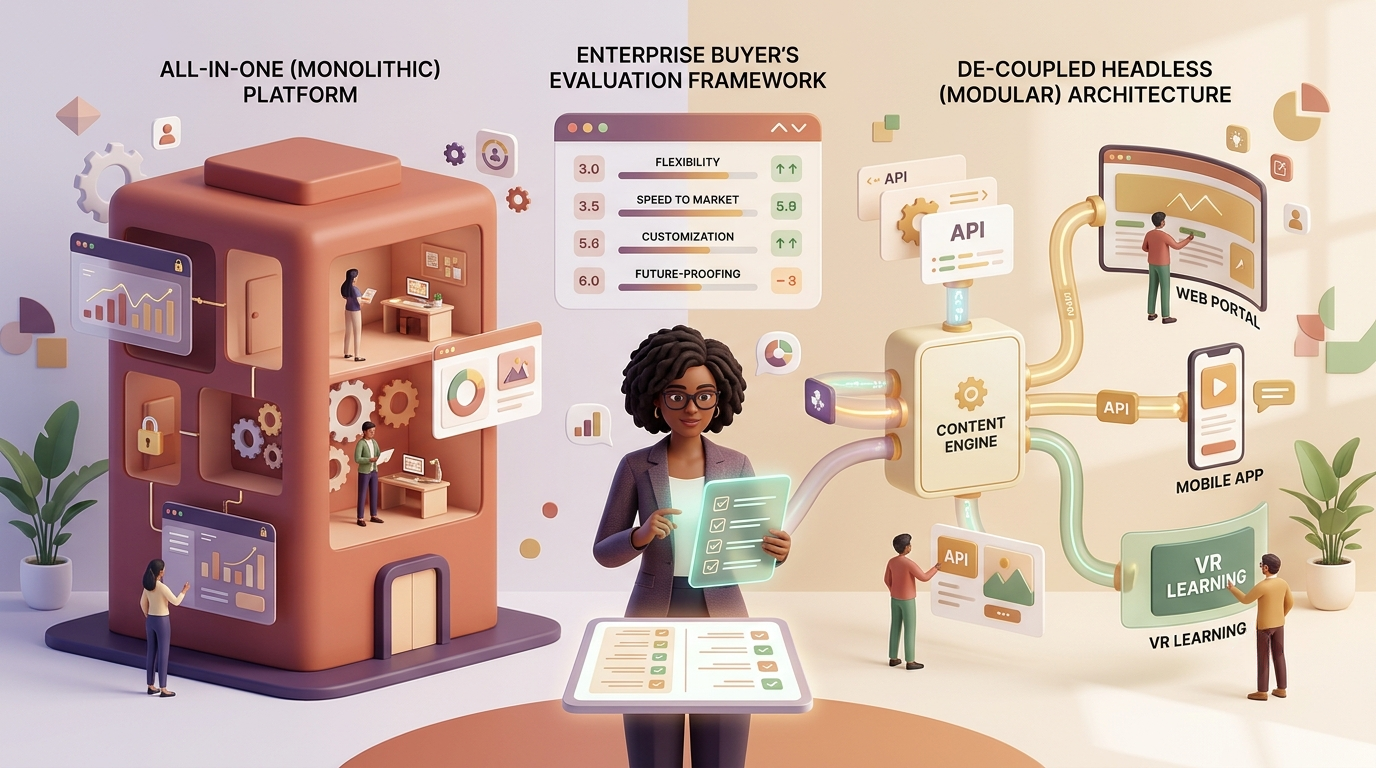
Core Anatomy: Monolithic vs. Headless LMS Architecture
Understanding the structural differences between monolithic and decoupled learning architectures is essential for evaluating total cost of ownership (TCO) and developer resource allocation.The Monolithic LMS
A monolithic LMS operates as a single, tightly coupled unit. The user interface (UI), business logic (enrollments, certifications, rules engines), database, and content players (SCORM, AICC) run on a unified tech stack. Customizing the user experience requires working within vendor-defined templates, proprietary theme engines, or fragile CSS overrides. Data extraction typically relies on scheduled, batch CSV exports rather than real-time event distribution.The Headless LMS
A headless LMS architecture isolates the core learning infrastructure—progress tracking, completion evaluation, access control, and telemetry—behind robust RESTful and GraphQL APIs. The presentation layer is omitted entirely from the vendor codebase. Instead, enterprise engineering teams can build bespoke frontends using modern frameworks (such as React, Vue, or native mobile SDKs). Learning experiences can be embedded natively across employee intranets, customer-facing SaaS applications, or CRM environments like Salesforce.Comparative Analysis: Lifecycle Mismatch, Velocity, and TCO
Evaluating headless versus monolithic platforms involves assessing technical longevity, integration capabilities, and long-term costs.Decoupled Architectural Lifecycles:
Digital design standards, frontend frameworks, and branding guidelines evolve every 3 to 5 years. In contrast, core enterprise learning databases and compliance records often endure for 8 to 12 years. Monolithic systems force organizations into disruptive, full-stack migrations simply to update a dated UI. A headless engine allows teams to iterate or rebuild the frontend layer without altering underlying compliance databases.Integration Velocity and Event-Driven Data:
Monolithic systems isolate learning records from broader business intelligence tools. Headless platforms leverage API endpoints and webhooks to stream xAPI statements and learner telemetry into enterprise data warehouses (such as Snowflake) and HRIS platforms in real time.Total Cost of Ownership (TCO) Realities:
Monolithic systems provide predictable, lower initial launch costs because the UI is prebuilt. However, they accumulate technical debt when organizations require custom workflows or multi-tenant branding. A headless architecture demands higher upfront capital investment for frontend engineering, but reduces ongoing maintenance costs by 30% to 50% across multi-portal, global enterprise environments.
The Enterprise Buyer’s Evaluation Framework
To determine architectural fit, enterprise learning technology leaders can assess their initiatives against four operational dimensions:Developer Availability and Maturity:
Headless platforms require sustained frontend engineering, testing, and accessibility maintenance (WCAG 2.1/2.2 compliance). If your organization lacks dedicated engineering support, a pure headless platform may introduce operational bottlenecks.Delivery Touchpoints:
If learning delivery occurs entirely through a standard web catalog, a monolithic or traditional platform may suffice. If training must be distributed across mobile field apps, embedded SaaS modules, and internal portals, an API-first approach is optimal.Brand Criticality and User Experience:
Customer, partner, and client-facing academies often demand bespoke brand experiences that off-the-shelf LMS templates cannot support.Standards Interoperability:
Ensure the headless engine natively handles legacy standards (SCORM 1.2/2004) while providing native support for modern protocols such as xAPI and cmi5 through headless content players.
When Not to Go Headless: Administrative Governance and Pitfalls
A headless architecture is not suitable for every operational model. Decoupling the frontend removes the default administrative user experience (AX). Non-technical instructional designers may lose visual, WYSIWYG course builders and drag-and-drop page editing tools unless the headless engine is paired with a headless Content Management System (CMS) or low-code portal.Furthermore, internal engineering teams must assume full responsibility for accessibility compliance, responsive interface testing, and ongoing API version management.
The Hybrid Approach: Modernizing Enterprise Learning Stacks
Enterprises do not always need to choose between a restrictive monolith and a complex, fully headless build. A practical middle ground is the composable hybrid model: retaining a stable, compliant LMS backend while deploying custom frontends or learning experience platforms (LXPs) on top via middleware and APIs.At Zilliobit, we assist enterprise leaders in evaluating their architectural maturity and implementing composable, API-driven learning platforms that balance developer velocity with administrative governance.
Find the Right LMS Architecture for Your Enterprise, Headless, Monolithic or Hybrid
Let’s Talk