LMS Consolidation Strategies: Managing Mergers, Multi-Tenant Portals, and Technical Debt
4 minutes to read

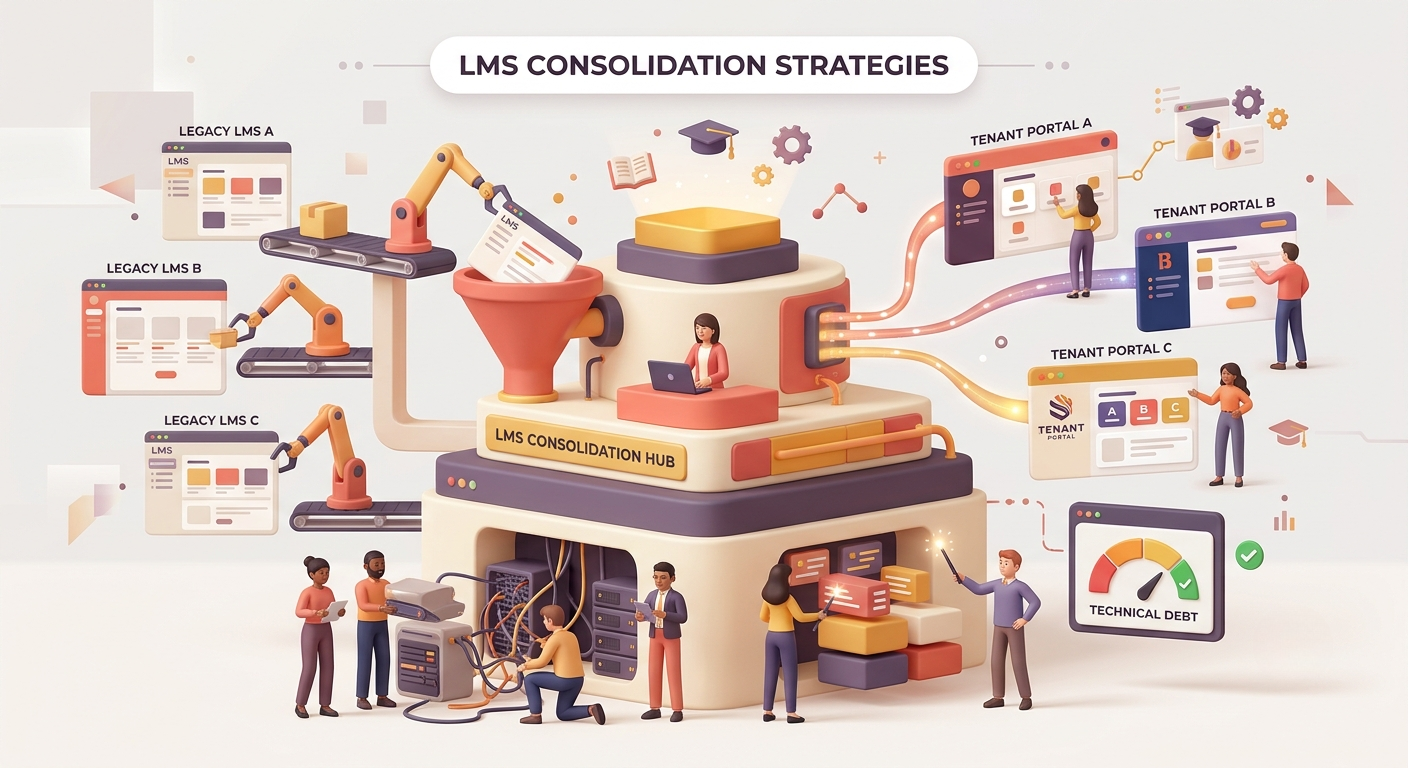
The Real Cost of LMS Sprawl and Unchecked Technical Debt
Enterprise expansion, decentralized procurement, and rapid mergers and acquisitions frequently leave enterprise IT and learning teams managing fragmented infrastructure. Industry research indicates that over 27% of enterprise organizations operate between two and five separate Learning Management Systems (LMS). Operating duplicate environments inflates software licensing and introduces severe governance risks, inconsistent training experiences, and fragmented compliance reporting.Developing an enterprise LMS consolidation strategy is no longer just a cost-containment exercise. Left unchecked, legacy platforms accumulate compounding technical debt: brittle integrations, unmaintained custom scripts, non-responsive course packages, and disparate learner identifier schemas across merged entities. Rationalizing disparate learning platforms onto a unified, modern infrastructure typically reduces operational and licensing costs by 30% to 55% while establishing a single source of truth for global workforce development.
Architectural Foundation: Leveraging Multi-Tenancy for Business Autonomy
A common roadblock during post-merger integration is the resistance from business units, subsidiaries, or external partner channels that require unique branding, discrete catalogs, or localized administrative rights. Attempting to solve this with isolated single-tenant instances simply reproduces platform sprawl under new licensing agreements.A scalable consolidation blueprint leverages modern multi-tenant LMS architecture. Under a multi-tenant model, organizations share a centralized codebase, database cluster, and integration backbone while logically isolating tenant-level data. This architecture delivers distinct advantages:
Delegated Administration:
Regional or departmental administrators control user groups, local reporting, and custom curricula without accessing neighboring tenant data.Independent Branding & Domains:
Each subsidiary or external audience accesses a custom-branded portal with independent domain masking and localized UI themes.Unified Identity and Access Management:
IT teams centralize Single Sign-On (SSO) protocols (SAML 2.0, OpenID Connect) and automated HRIS synchronization across the entire enterprise.Data Residency and Sovereignty:
Hybrid multi-tenant schemas allow sensitive customer or regional employee records to comply with cross-border mandates such as GDPR while retaining shared reporting capabilities.
Remediating L&D Technical Debt: Integrations, Schema, and Legacy Content
True platform consolidation requires auditing and refactoring the underlying technical debt that legacy systems leave behind. When auditing legacy platforms, learning technology leaders must address three core architectural layers:1. Integration Modernization
Legacy LMS environments often rely on point-to-point, scheduled flat-file (CSV) syncs or hardcoded database triggers to connect with HRIS and CRM platforms. Consolidating systems requires replacing brittle point-to-point scripts with centralized, event-driven RESTful APIs or webhook architectures that synchronize learner profiles in real time.2. User Schema Normalization
Acquired entities typically track users using divergent unique identifiers (e.g., internal employee ID vs. email address vs. Active Directory GUID). Consolidation roadmaps must define a canonical user data model and implement automated extract, transform, load (ETL) pipelines to reconcile duplicate accounts, historical transcripts, and hierarchy trees.3. Courseware Rationalization
Legacy systems are notorious repositories for outdated, non-responsive SCORM 1.2 packages or deprecated rich media formats. Leaders should audit content catalogs to deprecate redundant courses and migrate critical modules to modern, mobile-first standards such as xAPI (Experience API) or cmi5, decoupling tracking logic from the legacy player.
Compliance Migration: Separating Operational Data from Historical Archives
One of the most complex phases of post-merger LMS consolidation involves regulatory compliance records. Migrating decades of auditable completion records—required by regulators such as OSHA, the FDA (21 CFR Part 11), or financial oversight bodies—into an active production LMS often introduces severe database bloat and performance degradation.An optimal enterprise LMS consolidation strategy separates data into two pipelines:
Active Transcripts:
In-progress modules, current certifications, recurring compliance requirements, and active credentialing cycles are mapped directly into the new multi-tenant instance.Cold Compliance Archives:
Historical, inactive training logs and versioned completion certificates are exported into immutable, queryable data lakes or cloud archives. This structure satisfies regulatory discovery requirements while keeping the operational production database agile and performant.
A 5-Phase Roadmap for Seamless Consolidation
To mitigate operational disruption across 24/7 global operations, learning architects should adopt a phased cutover framework:Discovery & Portfolio Audit:
Catalog all learning applications, contract lifecycles, custom integrations, content formats, and compliance requirements across subsidiaries.Schema and Tenant Blueprinting:
Define the multi-tenant hierarchy, role-based access control (RBAC) tiers, identity management providers, and canonical user schemas.ETL Pipeline & Data Cleansing:
Reconcile duplicate learner accounts, clean up inactive users, and map legacy historical data to designated cold-storage archives.Pilot Portal Launch:
Deploy the consolidated multi-tenant platform for a single acquired subsidiary or business unit to validate administrative isolation and SSO sync workflows.Phased Dual-Run & Sunsetting:
Execute phased cutovers across remaining business units with minimal dual-run overlap, permanently decommissioning legacy platforms to eliminate maintenance costs.
Consolidate Your LMS Sprawl into One Scalable, Multi-Tenant Learning Platform
Let’s Talk