Beyond Prompts: How AI Agents Are Transforming Instructional Design
4 minutes to read

While this produced immediate time savings, it quickly revealed critical flaws. Single-turn prompts treat instructional design as a linear text generation task rather than an evidence-based pedagogical engineering process. The result? Context amnesia, hallucinated domain nuances, misaligned learning objectives, and an influx of low-value “content slop” that demands extensive manual remediation.
To address these issues, the industry is adopting AI agents in instructional design. Instead of using separate prompts, teams can use several AI agents that work together and follow proven learning principles.
The Collapse of the Prompt-and-Paste Workflow
Single-prompt authoring fails complex educational projects because traditional Large Language Models (LLMs) lack intrinsic pedagogical awareness. When tasked with producing entire courses in one pass, models fail to enforce backward design, balance cognitive load, or scaffold complex concepts systematically.Without an architectural framework, prompting leads to:
-
Objective and Assessment Misalignment:
Verbs in learning objectives (e.g., analyze, evaluate) frequently mismatch the factual recall nature of the generated quiz questions. -
Loss of Nuanced Enterprise Context:
Generic models overlook proprietary policies, internal systems, and real-world SME insights. -
QA Fatigue:
Instructional designers spend more time correcting inaccurate assertions and bland instructional phrasing than they would drafting materials manually.
Architectural Shift: Single Prompts vs. Multi-Agent Systems
Unlike passive chatbots waiting for input, agentic AI operates semi-autonomously using structured design patterns: planning, tool execution, memory, and iterative self-critique.Rather than forcing a single LLM prompt to juggle subject matter expertise, curriculum structure, tone, and accessibility guidelines simultaneously, multi-agent systems divide responsibilities across specialized agent personas.
Recent academic research into agentic learning engineering emphasizes that embedding structured learning frameworks—such as the Knowledge-Learning-Instruction (KLI) framework, Bloom’s Revised Taxonomy, and Gagné’s Nine Events of Instruction—into collaborative multi-agent architectures produces significantly higher pedagogical rigor and classroom readiness than single-agent baselines.
Blueprinting a Multi-Agent Instructional Design Engine
A production-ready multi-agent design pipeline delegates tasks across distinct sub-agents, each assigned a specific role and clear evaluation rubric:-
1. Needs Analysis & Competency Agent:
Analyzes target learner profiles, performance gaps, and business KPIs to generate measurable, verifiable learning objectives. -
2. SME Knowledge Retrieval Agent:
Uses Retrieval-Augmented Generation (RAG) to query unstructured internal documentation, policy PDFs, and SME interview transcripts, surfacing grounded facts and preventing hallucination. -
3. Lead Instructional Designer:
Determines the macro-structure of the curriculum using backward design principles, mapping prerequisites, module pacing, and cognitive progression. -
4. Scenario & Practice Author Agent:
Crafts contextual branching scenarios, authentic dilemmas, and deliberate practice activities that mirror day-to-day workplace challenges. -
5. Pedagogical QA Reviewer Agent:
Evaluates draft content against strict instructional criteria (e.g., Quality Matters standards, accessibility guidelines, cognitive load thresholds) before any human sees it.
How AI Agents Review and Improve Each Other’s Work
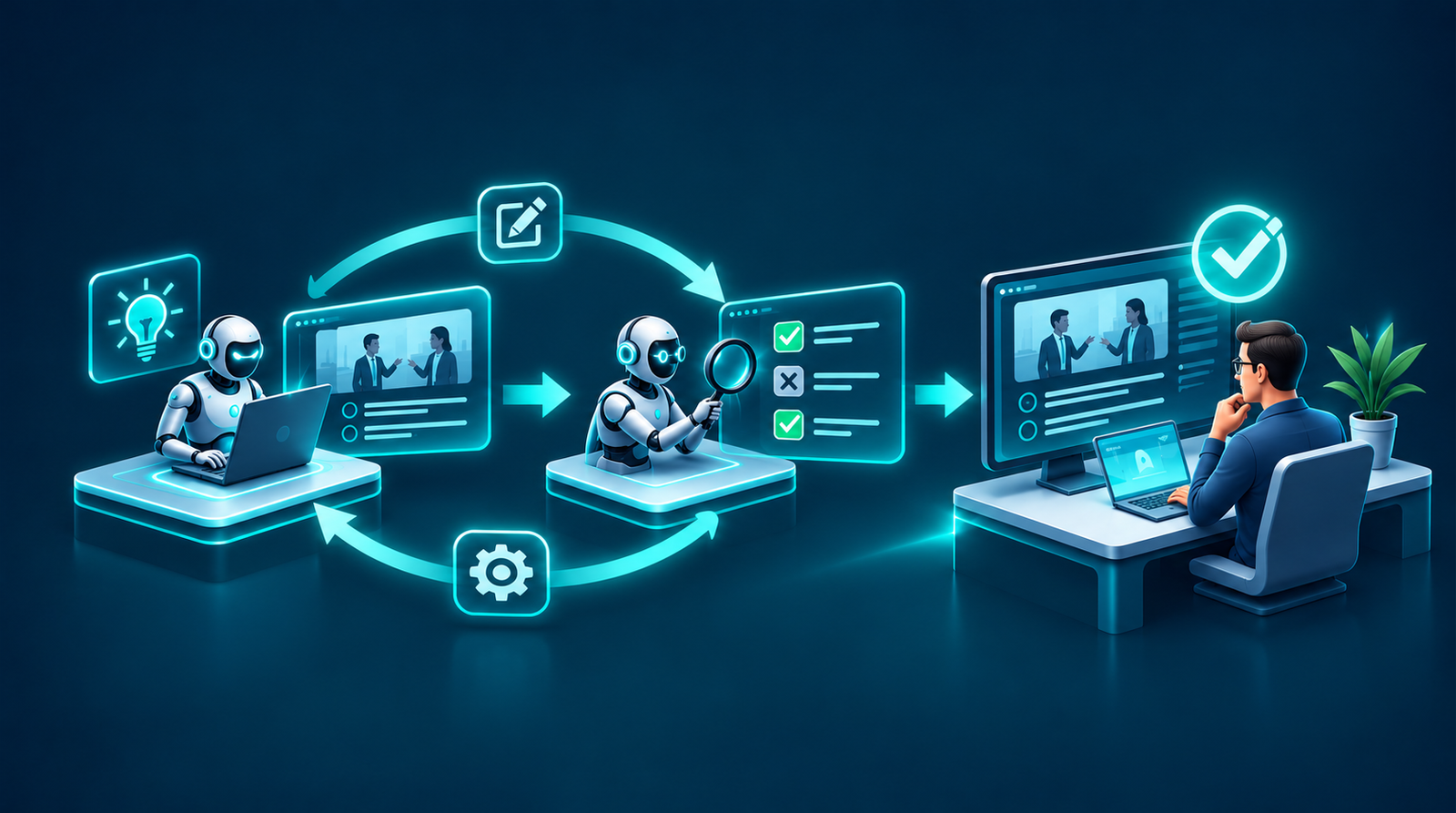
AI workflows are most effective when agents review and improve each other’s work. In a traditional step-by-step process, mistakes can pass from one stage to the next. In a multi-agent system, one agent creates the content, another reviews it, and the results are combined into an improved version.For example, when the Scenario Author Agent writes an interactive case study, the draft is passed directly to the QA Reviewer Agent. The reviewer checks:
-
Does the scenario require the learner to apply procedural knowledge, or does it merely test memorization?
-
Are distractors plausible and grounded in documented misconceptions?
-
Does the reading level match learner demographics?
The Elevated Role of the Lead Instructional Designer
Adopting multi-agent architectures does not eliminate the instructional designer; it elevates them.Instead of mainly writing content, instructional designers become solution providers and quality reviewers. Their key responsibilities include:
-
Setting Clear Guidelines:
Giving AI agents clear instructions on what to do, how to communicate, and which learning standards to follow. -
Facilitating SME Alignment:
Guiding proprietary domain knowledge intake and validating complex cases. -
Human-in-the-Loop (HITL) Governance:
Making sure the content is empathetic, culturally appropriate, and aligned with business goals.
Ready to move beyond prompts and build AI agent workflows that deliver pedagogically
sound learning content at scale?
Let’s Talk