Structuring Enterprise AI Literacy: Beyond Prompt Engineering to Operational Capability
4 minutes to read

The False Comfort of the Prompting Masterclass
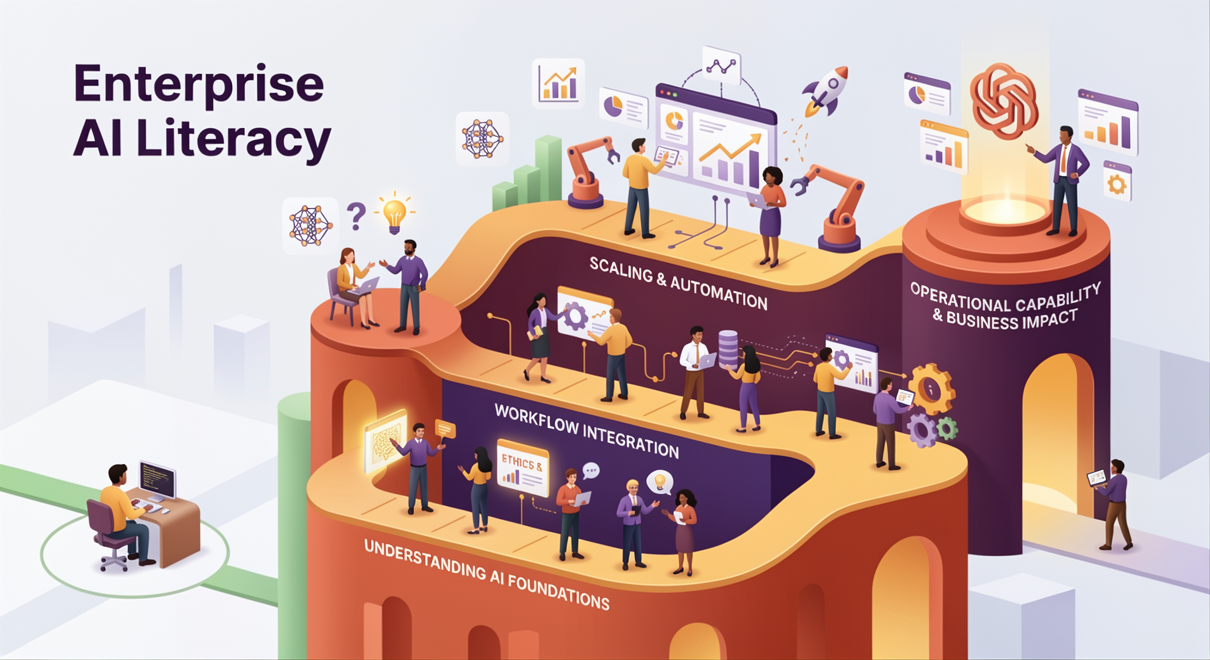
Across modern enterprises, learning and development leaders are confronting a frustrating paradox. While investments in generative AI licenses and introductory prompt-crafting workshops have surged, operational transformation remains stalled. High LMS completion rates frequently mask a stark operational reality: employees may know how to trigger an AI model with clever syntax, but they lack the judgment required to integrate autonomous outputs safely into mission-critical workflows.Treating prompt engineering as the pinnacle of workforce enablement is an expensive strategic detour. Real organizational readiness requires a structured enterprise AI literacy training program that shifts focus away from novelty tricks and toward sustainable operational capability, critical evaluation, and compliance.
Diagnosing the Capability Deficit in Enterprise AI
Recent data illustrates the divide between superficial tool usage and actual operational competence. Harvard research indicates that only 25% of enterprise workers demonstrate high generative AI fluency. More critically, Gartner findings reveal that only 8% of managers possess the operational skills necessary to direct AI effectively within team workflows.When training focuses solely on syntax, organizations create hidden liabilities. Industry research highlights that up to 77% of employees lack the evaluative skills needed to identify model hallucinations, audit underlying bias, verify citations, or prevent accidental leaks of intellectual property. Without structural training in critical output assessment, speed simply accelerates error propagation.
Furthermore, superficial automation exposes organizations to long-term talent risks. Gartner predicts that 30% of employees replaced by premature AI automation will need to be rehired at higher costs by 2029 if leaders fail to overhaul workforce planning and skill architectures prior to restructuring. Sustainable enablement requires treating AI as an amplifier of human expertise rather than a blunt instrument of workforce reduction.
The Core Pillars of Operational AI Literacy
Modern frameworks, such as the US Department of Labor’s AI Workforce Literacy Framework, reposition prompting as merely one operational sub-skill. A comprehensive enterprise program must be built upon four foundational pillars:Model Boundaries and Technical Foundations:
Helping staff understand deterministic systems versus probabilistic large language models, context windows, and structural limitations.Task-Level Safe Use and Data Governance:
Instilling rigorous operational boundaries regarding data classification, intellectual property rights, and secure query protocols.Evaluative Literacy and Output Auditing:
Training employees to systematically stress-test, fact-check, and audit AI outputs before incorporating them into business artifacts.Contextual Workflow Redesign:
Moving beyond automating existing inefficient steps to redesigning end-to-end operational processes with humans firmly in the loop.
Role-Differentiated Learning Pathways
A monolithic, one-size-fits-all curriculum rarely moves operational needles. L&D leaders must segment capability development into distinct tiers:Frontline Practitioners:
Training focuses on contextual task execution, secure prompt structuring, output verification methodologies, and proprietary data handling.People Managers:
Enablement emphasizes resource allocation, identifying high-leverage AI opportunities, evaluating team-level algorithmic outputs, and cultivating psychological safety to eliminate “shadow AI” habits.Executive Sponsors:
Learning targets strategic governance, compliance exposure, capital allocation, and long-term operating model evolution.
Regulatory Drivers: Operationalizing EU AI Act Article 4
AI literacy is no longer just a productivity lever; it is becoming a corporate governance mandate. Under Article 4 of the European Union AI Act, organizations deploying AI systems are legally required to ensure their personnel maintain sufficient AI literacy, taking into account their technical knowledge, experience, and operational context.An ad-hoc lunch-and-learn is insufficient to meet institutional governance thresholds. Forward-thinking talent leaders are aligning their training architectures directly with global compliance benchmarks to ensure auditable, defensible competence across all operational departments.
Measuring Business Impact Beyond LMS Vanity Metrics
To justify ongoing investment, L&D executives must abandon vanity metrics such as video views and completion badges. Strategic metrics must track tangible behavioral shifts:Error Reduction Rates:
Measured decrease in AI-generated hallucinations and inaccuracies surviving into client-facing deliverables.Cycle-Time Velocity:
Documented efficiency gains in core functional tasks, such as contract review, code refactoring, or customer ticket resolution.Governance Adherence:
Reduction in unapproved third-party tool usage through the adoption of sanctioned, secure enterprise workflows.
Building Sustainable Capability with Zilliobit
Moving an enterprise from experimental prompting to coordinated operational execution requires more than generic templates. It demands an enterprise architecture that integrates learning pathways directly into everyday tooling and governance structures. Zilliobit helps enterprise leaders design and implement structured enablement frameworks that turn AI potential into measurable, compliant, and resilient business capability.Turn AI Tool Access into Real Operational Capability
Let’s Talk